TutorAssist: AI-Enhanced Tutoring Platform
A full-stack tutoring platform with AI-generated questions tailored to each student's syllabus and weak areas, progress tracking for tutors, and adaptive practice with spaced repetition.
- ▸AI-powered question generation via GPT-4o-mini, tailored to each student's syllabus, grade level, and identified weak areas
- ▸Dual-interface platform: tutors track student progress and manage content; students practice with adaptive questions and progressive hints
- ▸Supports 12+ mathematical answer formats (expressions, matrices, coordinates, vectors) with MathLive input and KaTeX rendering
- ▸Spaced repetition scheduling, streak tracking, and similarity search via pgvector for intelligent question bank management
Overview
I tutor students in mathematics, and I built this platform to make my own tutoring more effective. The core idea: instead of manually creating practice questions or assigning from a textbook, the platform generates questions tailored to each student's specific syllabus, grade level, and identified weak areas, then tracks their progress so I can see exactly where they need help before our next session.
It serves both sides of the tutoring relationship: students get adaptive practice with immediate feedback, and I get visibility into what's actually working.
For Students
- Adaptive practice: AI generates questions based on their specific curriculum (IB, NSW HSC, etc.), current topic, and difficulty level
- Progressive hints: stuck students can request hints before seeing the full solution
- MathLive input: proper mathematical expression entry (fractions, matrices, coordinates, vectors, not just typing text)
- Spaced repetition: questions they struggled with resurface at optimal intervals
- Progress tracking: visual charts showing improvement over time, streak tracking for motivation
- Question flagging: students can flag confusing questions for me to review
For Tutors
- Student progress dashboard: see each student's weak areas, practice frequency, and improvement trends
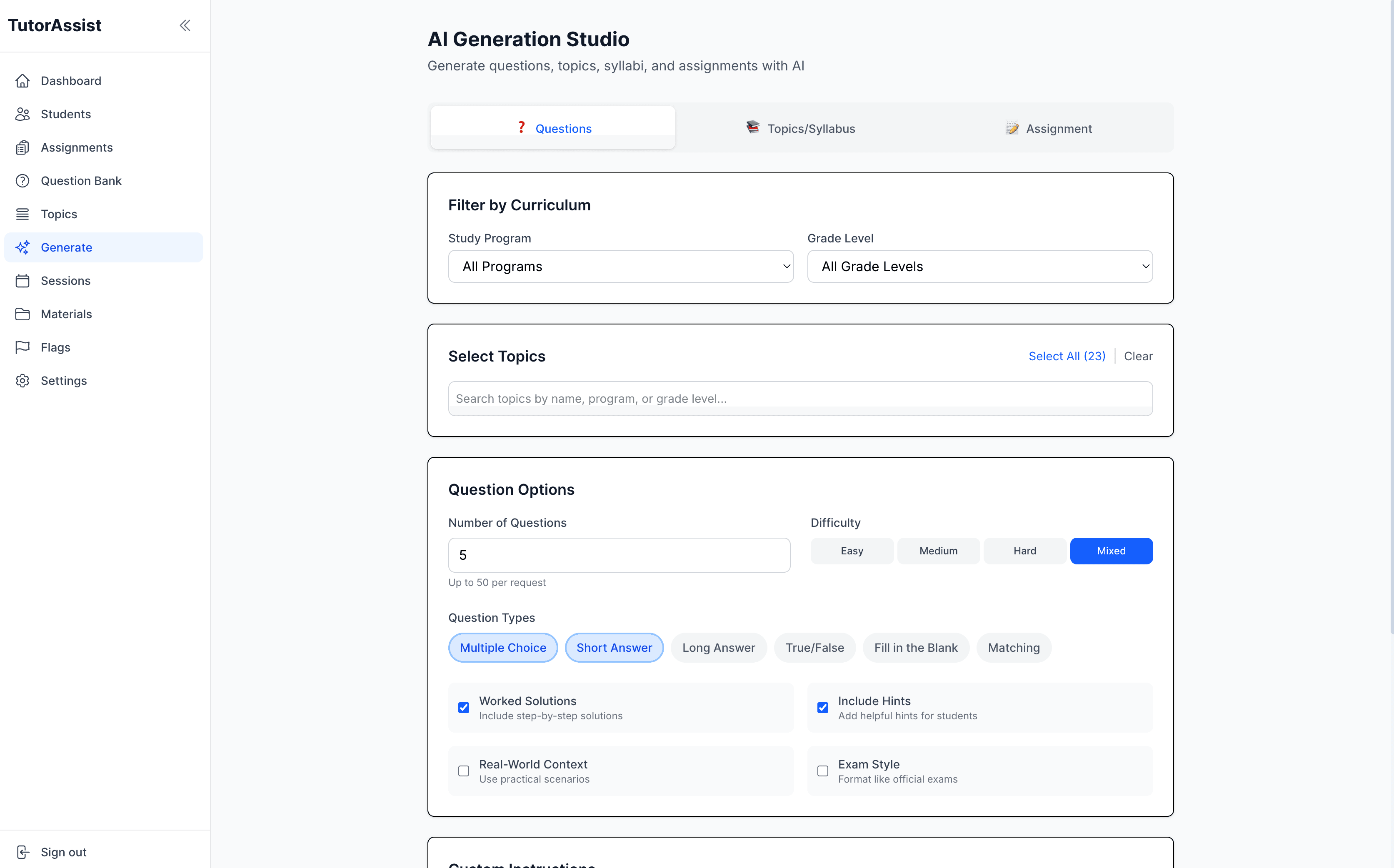
- AI question generation: generate questions with GPT-4o-mini, specifying topic, difficulty, and answer format
- Question bank: manage questions with LaTeX support and similarity search (pgvector) to avoid duplicates
- Assignments: create assignments with due dates, track completion
- PDF worksheet export: generate printable worksheets with optional answer keys
- Material uploads: attach PDFs, images, and reference materials to topics
- Google Calendar integration: schedule tutoring sessions directly from the platform
Technical Details
Stack: Next.js 15 (App Router), React 19, TypeScript, Tailwind CSS
Backend: Supabase (PostgreSQL with pgvector extension, Row Level Security for data isolation between tutors' workspaces), Supabase Auth
AI: OpenAI API, GPT-4o-mini for question generation, text-embedding-3-small for similarity search across the question bank
Math rendering: MathLive for input, KaTeX for display, supports numeric, expressions, multiple choice, fractions, coordinates, matrices, sets, ranges, complex numbers, vectors, equations, inequalities, intervals, and values with units
Storage: Cloudflare R2 for uploaded materials (PDFs, images)
Background jobs: Job queue pattern for long-running operations (AI generation, PDF creation, embedding computation)
Security: Row Level Security ensures complete data isolation between tutor workspaces: students only see their own data; tutors only see their own students
What I Learned
- Building for yourself as the user gives you an unfair advantage in product decisions: I know exactly which features matter because I use them weekly
- Supabase's Row Level Security is excellent for multi-tenant isolation without application-level complexity
- Mathematical input is a surprisingly hard UX problem. MathLive handles it well, but integrating it with validation across 12+ answer formats took significant effort
- GPT-4o-mini is good enough for question generation when you give it proper curriculum context, and significantly cheaper than GPT-4 for this use case